
Research quality · Reproducibility · Animal research
ARRIVE vs PREPARE: reporting is not the same as planning
Two acronyms dominate the conversation about rigour in animal research — ARRIVE and PREPARE. They are often mentioned in the same breath, as if interchangeable. They are not. One tells you how to report a study after it is finished; the other tells you how to plan it before it begins. Knowing the difference is the difference between fixing a paper and fixing a study.
You cannot fix a study by reporting it well
A decade of reproducibility audits has made one thing uncomfortably clear: a large fraction of published animal research cannot be reliably reproduced, and the causes are frequently baked in long before a single word of the manuscript is written [5]. Better reporting exposes those problems — it does not prevent them. This is the sentence Norecopa repeats: we cannot improve our research by better reporting alone [3]. ARRIVE and PREPARE sit at opposite ends of the study lifecycle, and that timing is the whole point [1][2].
ARRIVE — the reporting guideline
ARRIVE — Animal Research: Reporting of In Vivo Experiments — is a checklist for describing animal studies transparently and completely enough that others can evaluate and reproduce them [1]. The 2020 revision, ARRIVE 2.0, reorganised the checklist into an Essential 10 — the items without which a study cannot be assessed (study design, sample size, inclusion/exclusion criteria, randomisation, blinding, outcome measures, statistical methods, experimental animals, procedures, and results) — and a Recommended Set that adds context [1][4]. Crucially, ARRIVE operates at the end of the lifecycle: it governs the write-up, not the work [1].
PREPARE — the planning guideline
PREPARE — Planning Research and Experimental Procedures on Animals: Recommendations for Excellence — is Norecopa's checklist for everything that should happen before an animal experiment starts [2][3]. It spans 15 topics in three groups. Formulation of the study: literature searches, legal issues, ethical review and harm–benefit assessment, and experimental design and statistics. Dialogue between scientists and the animal facility: objectives and timescale, facility evaluation, education and training, and health-and-safety risks. Methods: test substances, experimental animals, quarantine and health monitoring, housing and husbandry, experimental procedures, humane killing or rehoming, and necropsy [3].
Here is the part that matters for the comparison. Several PREPARE items — facility evaluation, staff education and training, the dialogue between scientists and technicians, quarantine and health monitoring, housing and husbandry, and necropsy — are not typically highlighted in reporting guidelines at all [3]. These are the upstream, human-and-facility factors that quietly determine whether an experiment is even worth reporting — and they are invisible to a checklist you fill in at submission [3].
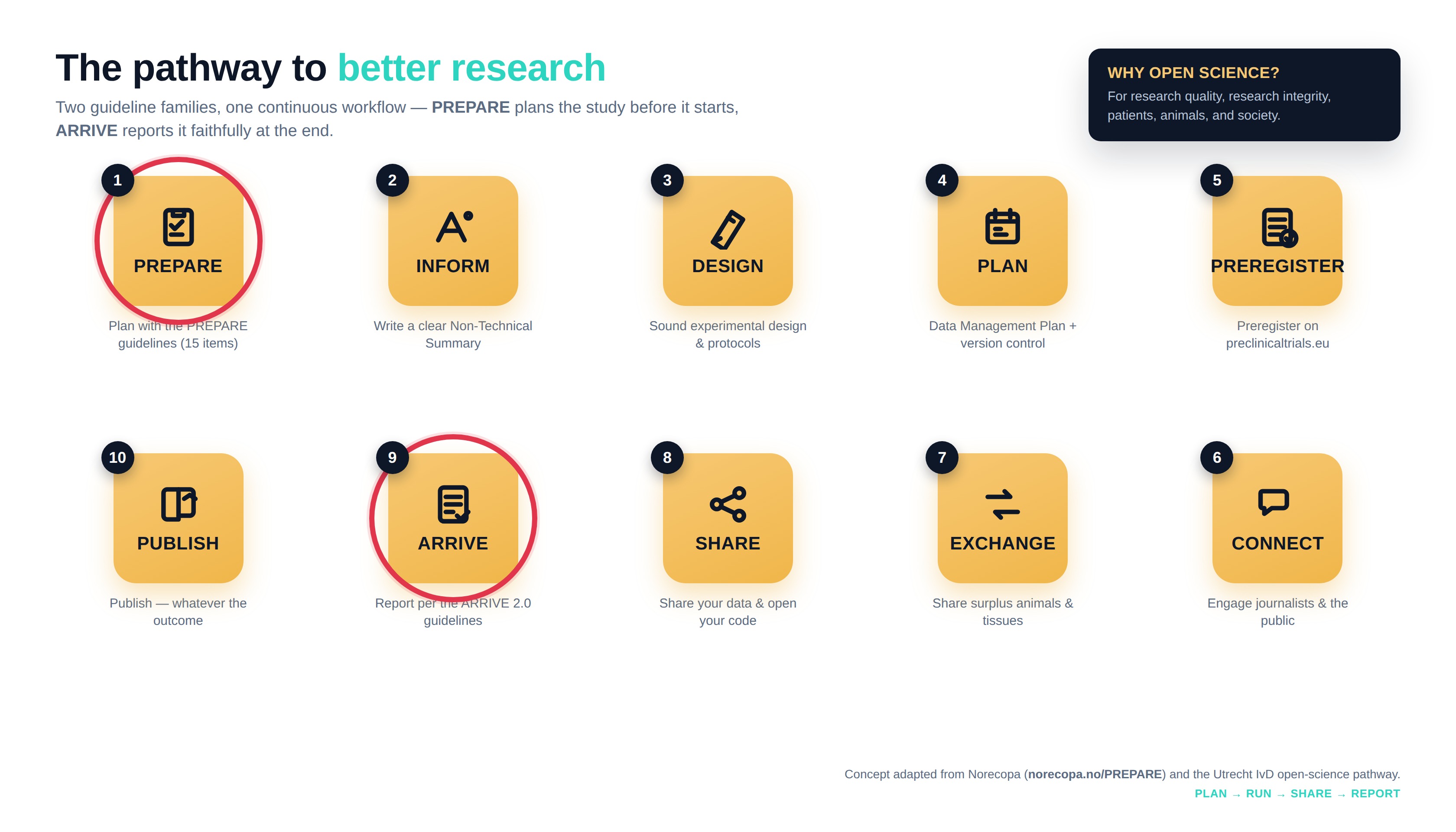
One pathway, not two rival checklists
Framed as rivals, ARRIVE and PREPARE force a false choice. Framed as a pathway — the way Norecopa and Utrecht draw it — they are simply two stations on the same line [3][6]. A study moves from PREPARE (plan with the guidelines) through INFORM (a clear non-technical summary), DESIGN (sound experimental design), PLAN (a data-management plan and version control), and PREREGISTER (on preclinicaltrials.eu), then CONNECT, EXCHANGE and SHARE, before it reaches ARRIVE (report faithfully) and PUBLISH — whatever the outcome [6]. PREPARE's payoff, in Norecopa's own summary, is fourfold: better science, improved animal welfare, advancement of the 3Rs, and a safer working environment [3].
The aviation lesson: checklists act before, not after
Norecopa's argument leans on aviation, and the analogy is apt. Pilots run ten to fifteen checklists even on short routine flights — not to document what went wrong afterwards, but to reduce the risk of forgetting a vital action, enforce the right sequence, cross-check between crew, and keep everyone on the same page [3]. The same logic underlies the Swiss-cheese model of failure: weaknesses only cause harm when they line up, and the way to break the alignment is to identify and control the critical points of an experiment in advance — because animals, like aircraft, are complex, tightly-coupled systems where one unmanaged variable propagates [3].
Why this matters for data and metadata
For anyone working on FAIR data or home-cage monitoring, PREPARE lands on a familiar truth: the metadata that makes a dataset reusable is decided at the planning stage, not scraped together at publication [2]. The pathway's PLAN step — a data-management plan and version control set up before the first animal is enrolled — is exactly where housing, husbandry, health-monitoring and procedural details can be captured as structured metadata rather than reconstructed from memory months later [6]. Do the PREPARE work up front and ARRIVE-quality reporting — and genuinely FAIR data — become a by-product of good planning rather than a scramble at the end.
Evidence at a glance
Cited by other notes Unique to this note Further reading
How this note arguescited 7consensus 1inference 4Neuronautix view 5hypothesis 1
References
- [1] The ARRIVE guidelines 2.0: updated guidelines for reporting animal research — Percie du Sert N, et al., PLOS Biology, 2020. Defines ARRIVE 2.0 and its Essential 10 / Recommended Set for transparent reporting of in vivo research.
- [2] PREPARE: guidelines for planning animal research and testing — Smith AJ, Clutton RE, Lilley E, Hansen KEA, Brattelid T, Laboratory Animals, 2018. Introduces PREPARE as a planning guideline that complements reporting guidelines.
- [3] PREPARE checklist and guidelines — Norecopa (Norwegian 3R centre). The 15-topic checklist, the items not covered by reporting guidelines, the aviation/quality-assurance framing, and the "better science / welfare / 3Rs / safety" outcomes (source of the uploaded slide deck).
- [4] ARRIVE guidelines website — NC3Rs. Full text of the Essential 10 and Recommended Set with explanation and elaboration.
- [5] 1,500 scientists lift the lid on reproducibility — Baker M, Nature, 2016. Survey evidence that a large share of published research, including in biology, fails to reproduce.
- [6] Better animal research through open science — Utrecht University Instantie voor Dierenwelzijn (IvD). The open-science "pathway" placing PREPARE and ARRIVE within a full plan-to-publish workflow.
Work with Neuronautix
Build the planning stage into your data workflow
Neuronautix provides independent consulting on Home-Cage Monitoring, FAIR metadata, behavioral data analysis, and scientific software. If PREPARE-quality planning and ARRIVE-quality reporting feel disconnected from your data pipeline, that gap is exactly what we help close.