For ethics committees, IACUCs & research funders
Plan before you report
ARRIVE and PREPARE are named in the same breath, as if interchangeable. They are not — and the difference is where oversight has its greatest leverage.
Damien Huzard, PhD · Neuronautix · 2 July 2026
We cannot improve our research by better reporting alone.
— Norecopa, on the case for planning guidelines
The problem
Most flaws are baked in before the first word is written
A large share of published animal research cannot be reliably reproduced. Better reporting exposes those problems; it cannot prevent them. Reporting checklists act at the manuscript stage — long after the design, the sample size, and the husbandry were fixed.
Two guidelines, one lifecycle
ARRIVE reports the study. PREPARE plans it.
PREPARE — before
Purpose: plan the experiment well
Timing: before any animal is used
Steward: Norecopa (Norwegian 3R centre)
Form: a 15-topic study-planning checklist
ARRIVE — after
Purpose: report the experiment fully
Timing: at manuscript submission
Steward: NC3Rs (UK)
Form: 21 items — the Essential 10 + a Recommended Set
ARRIVE 2.0 — the reporting checklist
The Essential 10
1 · Study design
2 · Sample size
3 · Inclusion & exclusion criteria
4 · Randomisation
5 · Blinding
6 · Outcome measures
7 · Statistical methods
8 · Experimental animals
9 · Experimental procedures
10 · Results
Without these ten, a study cannot be independently assessed or reproduced. A Recommended Set adds further context.
PREPARE — the planning checklist
15 topics, three conversations
Formulation of the study
Literature searches · legal & ethical review · harm–benefit and humane endpoints · experimental design & statistics.
Dialogue with the facility
Objectives, timescale & funding · facility evaluation · education & training · health, safety & waste.
Methods
Test substances · animals · quarantine & health monitoring · housing & husbandry · procedures · humane killing / rehoming · necropsy.
What reporting can't see
The items a reporting checklist never asks about
Norecopa flags these PREPARE topics as “not typically highlighted in reporting guidelines.” They decide whether an experiment is even worth reporting — and they are exactly where an ethics committee's or funder's questions have the most leverage.
The payoff
Better planning is better oversight
Prospective registration (e.g. preclinicaltrials.eu) is the planning-side complement funders and committees can ask for.
Takeaway
Plan before you report.
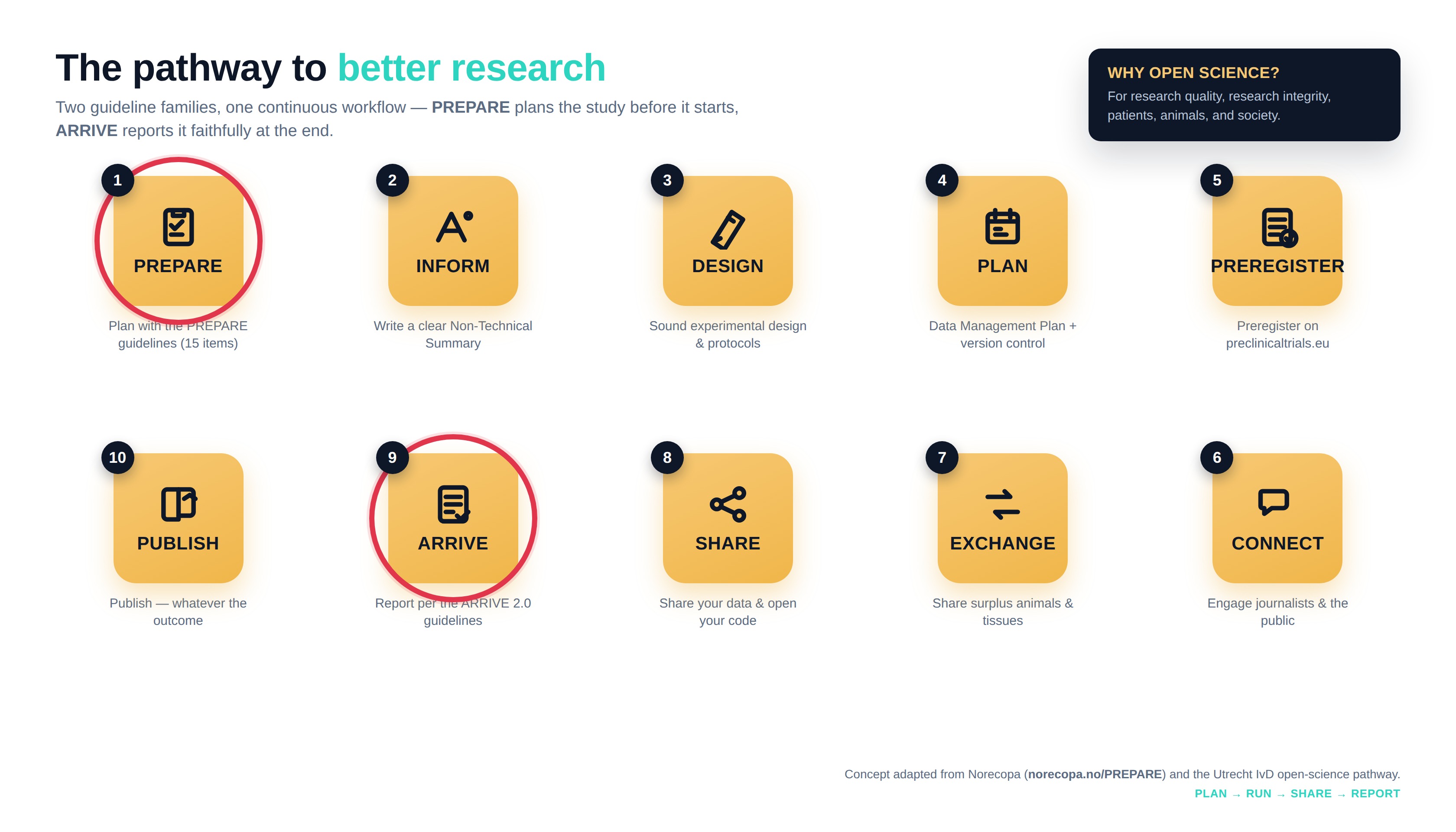
Ask for a PREPARE-style study plan and prospective registration at the proposal stage; expect ARRIVE-complete reporting at the end. The pathway runs from PREPARE to PUBLISH — reporting is the last mile, not the fix.
Sources: Norecopa PREPARE (norecopa.no/PREPARE) · ARRIVE 2.0 (arriveguidelines.org)
Damien Huzard, PhD · Neuronautix · companion note